Greenland: The Ultimate Guide to the World’s Largest Island (2026)
Hey bro, if you think the world only has hot deserts or lush green jungles worth seeing, hold up for a second. Today I’m gonna tell you all about Greenland, the world’s largest island that sounds like it should be super green… but dude, it’s basically a massive frozen wonderland covered in ice. The cold here is so intense you’ll want to grab a hot cup of coffee and just chill (literally). I’ve dug deep into this place, and I thought, why not write a full-on detailed blog post for junglejhadi.com in that chill, friendly vibe—like I’m sitting next to you explaining everything.
This is gonna be super informative about Greenland, covering geography, history, culture, economy, tourism, wildlife, and climate change impacts. Let’s get into it, grab a seat, and enjoy the ride. This post is all about Greenland facts and information, Greenland travel guide, and why this icy giant is so fascinating.
Greenland Info box
Feature | Detailed Information |
|---|---|
Ecosystem Type | Arctic Tundra & Glacial Ice Sheet |
Vegetation Zone | Low-Arctic and High-Arctic Tundra (No tall trees exist naturally) |
Dominant Flora | Dwarf Birch, Arctic Willow, Bell-heather, Mosses, Lichens, and Cotton Grass |
Iconic Wildlife | Polar Bear, Muskox, Arctic Fox, Arctic Hare, and Reindeer (Caribou) |
Marine Megafauna | Narwhal, Humpback Whale, Bowhead Whale, Walrus, and Ringed Seal |
Key Avian Species | White-tailed Eagle, Snowy Owl, Ptarmigan, and Atlantic Puffin |
Conservation Status | Home to the Northeast Greenland National Park (World’s largest) |
Soil Type | Permafrost (Permanently frozen ground) |
Daylight Patterns | Midnight Sun (Summer) and Polar Night (Winter) |
Highest Peak | Gunnbjørn Fjeld (3,694 m) |
Introduction to Greenland: The Giant Frozen Island
Bro, Greenland is officially the world’s largest island (not a continent, even though it looks huge on maps). Its total area is about 2,166,086 square kilometers— that’s like three times the size of Texas! Most of it (around 80-81%) is buried under the massive Greenland Ice Sheet, the second-biggest ice mass on Earth after Antarctica. It’s sitting way up north between the Arctic and North Atlantic Oceans, right next to Canada (just 26 km away at the closest point) and not too far from Iceland.
Population-wise, it’s super sparse—only around 56,000 people live here as of early 2026 (latest estimates hover between 55,600 to 57,000, depending on the source like Worldometer or Statistics Greenland). That makes it the least densely populated place on the planet, with folks mostly Inuit (about 88-90%) and the rest Danish or mixed. The capital is Nuuk, home to roughly 19,000-20,000 people—basically a third of the whole country lives there.
Greenland is an autonomous territory within the Kingdom of Denmark, so they handle their own internal stuff since the 2009 Self-Government Act, but Denmark takes care of foreign affairs, defense, and currency (Danish Krone). Economy is small but stable, with a GDP around $3-4 billion and high per capita income thanks to Danish subsidies (which cover a big chunk). For more solid facts, check out this Britannica page on Greenland.
Geography and Climate: A Land of Ice and Extremes
Bro, when you look at Greenland’s geography, it seriously blows your mind, it’s the world’s largest island, but most of it feels like one giant frozen blanket. The total area is about 2,166,086 square kilometers (around 836,330 square miles), which is more than three times the size of Texas and bigger than a bunch of European countries combined.
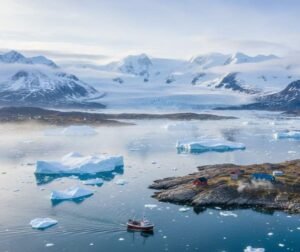
But here’s the shocking part: roughly 79-80% of that (about 1,710,000 square km or 660,000 square miles) is buried under the massive Greenland Ice Sheet, the second-largest ice mass on Earth after Antarctica.
This ice sheet is confusing—it’s almost 2,900 km long from north to south, up to 1,100 km wide at its broadest point near the north, and averages 1,500 meters (about 5,000 feet) thick. In the central areas, it gets even thicker, over 3,000 meters (10,000 feet) in places. All that weight is so heavy that it pushes the bedrock underneath way below sea level—if the ice ever fully melted (which would take centuries or millennia), Greenland might split into a few separate islands! For more on the ice sheet’s details, check out this solid page on Wikipedia’s Greenland Ice Sheet.
The coastline is super dramatic and jagged, stretching over 44,000 km (that’s longer than the Earth’s equator in some estimates when you count all the fjords). Those fjords are deep, narrow inlets carved by glaciers, and they’re everywhere, especially along the east and west coasts. The most famous one is the Ilulissat Icefjord, a UNESCO World Heritage site where the Sermeq Kujalleq glacier dumps thousands of tons of ice into the sea every day, creating gigantic icebergs that float around like floating mountains.
The highest point is Gunnbjørn Fjeld at 3,694 meters (12,119 feet), the tallest peak in the Arctic, sitting in the eastern Watkins Range. But most of the interior is this flat, endless white dome with no real peaks sticking out except for some nunataks (rocky islands in the ice).
Only about 20% of Greenland is ice-free, mostly narrow coastal strips with rugged mountains, rocky terrain, and tundra. Vegetation is sparse—moss, lichens, small shrubs like dwarf birch and willow. There’s one tiny forested area in the extreme south, in the Qinngua Valley near Cape Farewell, protected by mountains from cold winds, where summer temps let a few trees survive. No big forests anywhere else, though—it’s all tundra or barren rock.
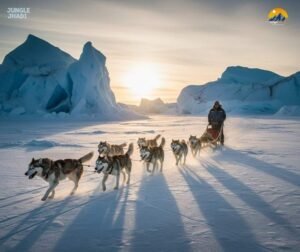
Travel is wild here—no roads connect the towns! You move by boat in summer, plane or helicopter year-round, or dog sled/snowmobile in winter over frozen seas. A short flight might be the only way to a nearby village across a fjord.
Now, onto the climate pure Arctic, dude. It’s tundra climate (Köppen ET) along the coasts and ice cap climate (EF) inland. Summers are short and cool, winters long and cold. The Gulf Stream keeps southern coasts a bit milder, but the ice sheet keeps the interior frozen year-round.
Temperatures vary a ton by region:
- South (like Nuuk): Winters average -7°C to -9°C (around 16-20°F), summers hit 7-10°C (45-50°F) on good days. Record highs have reached over 25°C in places.
- North (like Qaanaaq or Summit Camp): Brutal—winters drop to -30°C or lower (down to -67°C records), summers barely 0-5°C.
- Interior ice sheet (Summit Camp): Always below freezing, annual average around -30°C, with extremes from -43°C in winter to just above freezing in rare summer thaws.
Precipitation is low overall—south gets 800-1,900 mm a year (mostly snow), north and interior are desert-like with 50-200 mm. It’s dry because cold air holds little moisture.
The coolest things are the midnight sun and polar night. Above the Arctic Circle (covering two-thirds of Greenland), summer means the sun never sets for months—up to 154 days in the far north! Winter brings polar night, where the sun doesn’t rise for weeks or months. People adapt—long days for work in summer, cozy indoor life in the dark winter.
Weather flips fast—one minute sunny, next a howling blizzard. Foehn winds can blast at 80 mph and spike temps suddenly.
But climate change is hitting hard here. The Arctic warms twice as fast as the globe, and the ice sheet is losing mass every year. In 2024-2025, it lost around 105-129 gigatons of ice (NASA GRACE-FO data), continuing a trend since the 1990s. Glaciers are retreating, permafrost is thawing, and melt is accelerating. If it all melted (not anytime soon), sea levels would rise about 7.4 meters (24 feet). For the latest on this, head to Britannica’s Greenland page or NSIDC Ice Sheets Today.
Yar, Greenland’s geography and climate make it this harsh but incredibly beautiful place. Inuit people have thrived here for thousands of years, living in harmony with the ice. But now, with warming, everything’s changing—faster melt, shifting ecosystems, and big global impacts. It’s a reminder of how fragile and connected our planet is. If you’re planning a trip or just curious, respect the place—it’s not just ice, it’s a living, breathing world.
History of Greenland: From Ancient Hunters to Modern Autonomy
Dude, Greenland’s history goes back thousands of years. First people arrived around 2500 BC from North America—Paleo-Inuit cultures like Saqqaq, then Dorset, and finally the Thule people (ancestors of today’s Inuit) around 1100-1300 AD. They were masters of surviving in the cold, hunting with kayaks and dogs.
Then came the Vikings. In 982 AD, Erik the Red (exiled from Iceland) landed here and named it “Greenland” to attract settlers (smart marketing, right?). Norse colonies grew to a few thousand people, but they vanished by the 15th century—probably due to the Little Ice Age, conflicts with Inuit, and tough farming.
Denmark took over in the 18th century with missionary Hans Egede in 1721. It became a colony, then part of Denmark proper in 1953. Home rule came in 1979, and full self-government in 2009. During WWII, the US built bases here (Thule Air Base still exists). For a full timeline, Britannica’s history section is great.
Key historical milestones:
- 2500 BC: First human settlements.
- 982 AD: Erik the Red arrives.
- 1721: Danish colonization starts.
- 1979: Home rule.
- 2009: Self-government.
It’s a beautiful mix of Inuit resilience and European influence today.
Culture and Traditions: Inuit Heart with Modern Twists
Bro, the culture is mostly Inuit—strong connection to nature, hunting, storytelling. Language is Greenlandic (Kalaallisut), an Inuit tongue, but Danish and English are common too. Traditions include drum dancing, throat singing, and carving tupilaks (mythical figures from bone or stone).
Food is all about the sea: seal, whale (mattak is raw whale skin), fish like halibut. They have “kaffemik”—open-house coffee gatherings for birthdays or events. Inuit kiss (rubbing noses) is sweet. They celebrate National Day on June 21 with dances and games.
Modern life blends old and new—handball is huge, and music mixes traditional with rock. Religion is mostly Lutheran Christian. Check Visit Greenland’s culture page for more vibes.
Main cultural highlights:
- Inuit myths and spirits.
- Traditional clothing from animal skins.
- Festivals like National Day with drum dances.
- Mix of Inuit and Danish influences in food and daily life.
It’s a culture built to thrive in harsh conditions, but now evolving with tourism.
Economy and Industries: Fishing, Mining, and More
The economy relies heavily on fishing—90% of exports are shrimp, halibut, and cod. Danish block grant covers about 25% of budget. Mining is growing (rubies, gold, rare earths), but oil exploration stopped in 2021 for sustainability. Tourism is booming too. Unemployment is low, but inequality is high.
Key industries:
- Fisheries: Main export driver.
- Mining: Emerging with new minerals.
- Tourism: Adventure and nature focus.
- Hydropower: 67% of electricity is renewable.
Life is expensive, but wages are good. More on Wikipedia’s economy page.
Tourism Attractions: Adventure Awaits in Greenland
Yar, tourism is exploding here—perfect for adventure lovers. Go to Ilulissat Icefjord for massive icebergs (UNESCO site). Nuuk has museums, cafes, and modern Inuit art. Disko Bay for whale watching. Dog sledding in winter, kayaking in summer. Midnight sun and northern lights are magical.
Top spots:
- Ilulissat Icefjord: Iceberg cruises.
- Nuuk: Capital with culture and vibes.
- Disko Bay: Whales and glaciers.
- South Greenland: Sheep farms and hot springs.
- Northeast National Park: Remote wilderness.
Plan sustainable—check Visit Greenland for tips.
Here are some stunning visuals to get you excited:
These show the epic icebergs, fjords, and northern lights—pure magic!
Wildlife and Environment: Arctic Life Thriving
Bro, Greenland’s wildlife and environment are straight out of a frozen fairy tale—harsh, beautiful, and full of tough survivors that have mastered life in one of the planet’s most extreme places. Even though 80% of the island is buried under the massive ice sheet, the ice-free coastal areas, tundra zones, and surrounding seas are teeming with life. This is pure Arctic wilderness, where animals have adapted to freezing temps, long winters, short summers, and limited food. The Northeast Greenland National Park—the world’s largest national park—covers huge chunks of this untouched land, protecting it all with zero permanent human residents (just a handful of research stations). For more on the park, check out Visit Greenland’s page on the National Park.
The environment here is classic Arctic tundra: treeless, with permafrost (permanently frozen ground) locking everything in place. Vegetation is low and tough—mosses, lichens, grasses, sedges, dwarf shrubs like willow and birch, and in summer, colorful wildflowers pop up briefly. In the far south, there’s even a tiny protected valley with small trees, but mostly it’s barren rock, boggy spots, and low-growing plants that hug the ground to survive wind and cold. This fragile setup supports a surprisingly diverse crew of animals on land, sea, and air.
Let’s break down the main stars of Greenland’s wildlife:
Land Mammals – The Tough Land Crew
These guys roam the tundra and coastal areas, especially in the north and east.
- Polar Bear – The king of the Arctic, mostly in the north and east coasts. They hunt seals on sea ice and are super adapted to the cold.
- Musk Ox – These prehistoric-looking beasts with thick shaggy coats and curved horns live in herds on the tundra, especially northeast. They’re like big Arctic goats and graze on tough plants.
- Reindeer (Caribou) – Wild herds roam the west coast, migrating long distances for food. They’re fast and important for local hunting.
- Arctic Fox – Sneaky scavengers that change color—white in winter, brown/gray in summer—for camouflage.
- Others like Arctic hare (super fast and white in winter), collared lemming, ermine, and even some wolves in the east.
Marine Life – The Ocean Giants
The seas around Greenland are rich—cold waters full of fish, seals, and massive whales.
- Narwhal – The “unicorn of the sea” with that long tusk, mostly in the northwest and east. They dive deep under ice for food.
- Whales – Humpback, minke, fin, bowhead, beluga, and more. Humpbacks are super common in summer, breaching and singing.
- Seals – Ringed, harp, hooded, bearded—tons of them, especially ringed seals that polar bears love to hunt.
- Walrus in some coastal spots, plus fish like Arctic char and Greenland halibut.
Birds – The Sky Squad
Over 230 species, with about 60 breeding here. Seabirds dominate—puffins, guillemots, kittiwakes on cliffs. Land birds like gyrfalcon (world’s largest falcon), white-tailed eagle (huge wingspan, king of the skies), snowy owl, ptarmigan, and migratory ducks/geese.
Yar, this whole ecosystem is connected—polar bears hunt seals, foxes scavenge, birds eat fish, and everything depends on the short summer burst of plants and insects. But climate change is hitting hard and fast here. The Arctic is warming way quicker than the rest of the planet, and Greenland’s ice is melting at record rates (like 105 billion tons lost in 2024-2025). Sea ice is shrinking, permafrost is thawing, and that changes everything:
- Polar bears lose hunting platforms as ice disappears, forcing them to swim longer or go hungry.
- Narwhals and belugas struggle with less ice cover and changing food.
- Musk oxen face harder winters with more rain turning to ice crust, making it tough to dig for food.
- Vegetation is “greening”—more shrubs taking over tundra, which could shift habitats and release stored carbon from thawing permafrost.
- Marine ecosystems are shifting—warmer waters bring new fish but push out cold-loving species.
It’s a big wake-up call—these changes affect not just local Inuit hunters but global sea levels, weather patterns, and biodiversity. For the latest impacts, Visit Greenland’s Arctic Wildlife article has great info, or check NSIDC for ice updates.
Dude, Greenland’s wildlife isn’t just cool—it’s resilient proof of how life clings on in the toughest spots. But with warming accelerating, we gotta protect it. Sustainable tourism, less emissions, and respect for the land are key. If you’re dreaming of seeing this world, go responsibly—it’s one of the last true wild places left. Want details on spotting any specific animal or how to visit safely? Just say the word!
Climate Change Impact: The Biggest Threat
Bro, if there’s one thing that hits Greenland harder than anything else, it’s climate change. This place is literally on the front lines of global warming, and the changes happening here are scary fast and super visible. The Arctic is warming at least twice as fast as the rest of the planet (some studies say up to four times faster in certain spots), and Greenland is right in the middle of it all. The massive ice sheet, the sea ice, the permafrost, the animals, the people—everything is feeling the heat, and the consequences are not just local, they’re global.
The most dramatic and talked-about change is the melting of the Greenland Ice Sheet. This thing holds enough water to raise global sea levels by about 7.4 meters (24 feet) if it completely melted (which won’t happen overnight, but even partial melt is already a big problem). Since the 1990s, the ice sheet has been losing mass every single year, and the rate is accelerating.
- In the 1980s and early 90s: almost balanced (some years gained a little, some lost).
- 2000s onward: steady losses.
- Recent years (2020–2025): massive melt seasons. For example, in 2021 one of the biggest melt events ever recorded, and even in 2024–2025, the net loss was around 105–150 gigatons of ice per year (NASA GRACE-FO satellite data). That’s like losing a cube of ice 500 meters on each side every single year!
Glaciers are retreating at shocking speeds—some like Jakobshavn and Helheim have pulled back kilometers in just a couple of decades. Meltwater lakes form on the surface, then suddenly drain through huge cracks (called moulins) all the way to the bedrock, lubricating the ice and making it slide faster toward the sea.
Then there’s sea ice decline. The Arctic sea ice around Greenland is shrinking in extent, thickness, and duration. Less sea ice means:
- More dark ocean water absorbs heat (albedo effect), warming things even more.
- Polar bears have less platform to hunt seals → longer swims, more starvation risk.
- Inuit hunters can’t safely travel on traditional ice routes.
- Coastal erosion gets worse because waves hit the shore directly instead of being blocked by ice.
Permafrost thawing is another huge issue. Much of Greenland’s ice-free land has permafrost—ground that’s frozen for years or centuries. As it thaws:
- Buildings, roads, and runways in coastal towns become unstable (some houses already tilting or cracking).
- Ancient organic matter (plants, animals) that was locked in the ice starts decomposing → releases methane and CO₂, which are powerful greenhouse gases → speeds up global warming even more (positive feedback loop).
- Landslides and erosion increase.
Ecosystems are shifting too. The tundra is “greening”—more shrubs and taller plants are growing because summers are warmer and longer. This sounds good, but it changes habitats:
- Animals that depend on open tundra (like some birds or musk oxen) lose ground.
- New species (fish, insects, even southern plants) are moving north.
- Traditional hunting patterns change—seals move to different areas, fish stocks shift.
For the people, especially the Inuit communities, these changes are life-altering:
- Harder and more dangerous hunting and fishing.
- Food security issues (traditional diet of seal, whale, fish).
- Mental health impact from losing cultural practices tied to the ice.
- Some coastal villages facing relocation due to erosion and rising seas.
And globally? Greenland’s melt is already contributing significantly to sea level rise (about 0.8–1 mm per year right now, and increasing). That affects coastal cities everywhere—from Mumbai to Miami, Kolkata to New York. Plus changes in ocean currents (like the Atlantic Meridional Overturning Circulation) could mess with weather patterns worldwide.
For the most up-to-date data and visuals, check out these reliable sources:
- NASA’s Vital Signs – Ice Sheets – shows graphs of mass loss over time.
- NSIDC Ice Sheets Today – daily and seasonal melt updates.
- IPCC Reports on Cryosphere – detailed science on polar regions.
Yar, Greenland is like the planet’s early warning system. What happens here doesn’t stay here—it ripples out to the whole world. The good news? People are paying attention. Greenland’s government is pushing for sustainability, renewable energy (they already get a lot from hydropower), and international climate action. But we all have to do our part—reduce emissions, support clean energy, and spread awareness.
This isn’t just about ice melting—it’s about a whole way of life, an entire ecosystem, and the future of our oceans and coastlines. Greenland is beautiful, resilient, and incredibly important. We can’t afford to lose it. If you want more on specific aspects (like sea level rise projections or Inuit voices on this), just tell me.
Fun Facts About Greenland That’ll Blow Your Mind
- Largest island, tiniest population density.
- No roads between towns.
- Midnight sun for months.
- Name is a “sales pitch”—mostly ice!
- World’s largest national park (no people).
- Dog sleds still used for transport.
- Ancient mummies preserved in ice.
- Rich in minerals due to melt.
- High inequality despite wealth.
- No forests, but southern green spots.
Greenland – A Frozen Paradise We Must Protect
Bro, after all this, Greenland feels like another world—ice, history, tough but warm people, and beauty that hits you hard. If you’re planning a trip, go for adventure but respect the place. Climate change is real here, so let’s do our part to slow it. Thanks for reading on junglejhadi.com drop a comment if you have questions or wanna share your Greenland dreams. Next time, maybe another epic spot!
Greenland Real Questions, Straight Answers
Read this:
Q1. Greenland is so huge, then why isn’t it a continent?
Bro, size alone doesn’t make something a continent. A continent sits on its own tectonic plate. Greenland actually lies on the North American tectonic plate, so even though it looks massive on the map, it’s officially the world’s largest island, not a continent.
Q2. Why is it called “Greenland” when it’s mostly ice?
Haha, classic ancient marketing trick
In 982 AD, Erik the Red named it “Greenland” to attract settlers. Saying “Welcome to Frozen Hell” wouldn’t work, right? Southern Greenland does turn a bit green in summer, so the name kind of stuck.
Q3. Who lives in Greenland?
Mostly Inuit people (around 88–90%). The rest are Danes or people of mixed heritage. The total population is just 55,000–57,000, which is smaller than many Indian towns. Super low population density.
Q4. Is Greenland an independent country?
Not fully, bro. Greenland is an autonomous territory within the Kingdom of Denmark.
- Greenland controls internal governance
- Denmark handles defense, foreign affairs, and currency
Since 2009, Greenland has strong self-rule.
Q5. Why is life so expensive in Greenland?
Because almost everything is imported.
Food, fuel, clothes—all come by ship or plane. No road network between cities, extreme climate, and remote location make prices high. Danish subsidies help keep things stable.
Q6. Why are there no roads connecting towns in Greenland?
Bro, geography is brutal here.
Mountains, fjords, glaciers, ice, and permafrost make road construction nearly impossible. People travel by boats in summer, planes or helicopters year-round, and dog sleds or snowmobiles in winter.
Q7. How cold does Greenland actually get?
Depends on where you are: – South Greenland: winters around -7°C to -10°C
– North & interior: -30°C to -50°C, sometimes colder
At Summit Camp, it stays below freezing almost all year.
Q8. Can you see Northern Lights in Greenland?
Oh yes, big time
From September to April, Greenland is one of the best places on Earth to see the Aurora Borealis, especially in places like:
- Ilulissat
- Kangerlussuaq
- Northern Greenland
Q9. What is the best time to visit Greenland?
Depends on what vibe you want:
Summer (June–August):
- Midnight sun
- Hiking, kayaking
- Whale watching
Winter (November–March):
- Northern lights
- Dog sledding
- True Arctic adventure
Q10. What kind of animals live in Greenland?
Pure Arctic legends
- Polar bears
- Musk oxen
- Reindeer (caribou)
- Arctic foxes
- Whales (humpback, narwhal, beluga)
- Seals and seabirds
- Most of them are extreme cold survivors.
Q11. Is Greenland really affected by climate change?
Sadly, yes—big time.
Greenland is warming twice as fast as the global average.
- Ice sheet losing 100+ gigatons of ice per year
- Rising sea levels
- Wildlife and Inuit lifestyles under threat
- What happens here affects the whole planet.
Q12. Could Greenland become independent in the future?
Possible, but slow and careful. Greenland has: – Minerals
- Hydropower
- Growing tourism
But right now, Denmark’s financial support is still very important. Independence is a long-term discussion.
Q13. Is Greenland safe for tourists?
Yes, if you respect nature.
Weather changes fast, wildlife is real, and distances are huge. Traveling with local guides and following safety rules makes it a safe and unforgettable experience.
Q14. Why is Greenland so important for the world?
Bro, Greenland is like Earth’s warning system
Ice melt here affects: – Global sea levels
- Ocean currents
- Weather patterns worldwide
- Scientists closely watch Greenland for future climate predictions.
Q15. Is Greenland just ice, or is there more to it?
Way more, bro: – Ancient Inuit culture
- Massive fjords
- Midnight sun
- Northern lights
- Peace and silence you won’t find anywhere else
Greenland isn’t just a place—it’s a whole experience.
Final Bro Note
Don’t think of Greenland as just a frozen land. It’s a living example of how humans, wildlife, and nature survive together in extreme conditions. Understanding Greenland helps us understand the future of our planet.