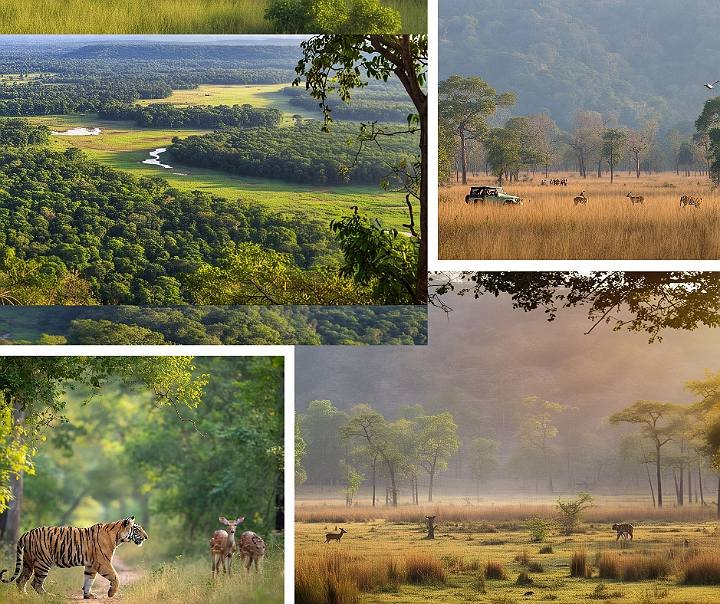
Kaziranga National Park Guide: Everything You Need to Know Before Visiting
Hey friends, namaste! I’m Amit, and today on junglejhadi.com I’m sitting here chatting with all of you about Kaziranga National Park. Yaar, honestly, whenever I think about this place in Assam, I get this baffling excitement in my heart. Those vast grasslands, the banks of the Brahmaputra River, and in between, one-horned rhinos casually walking around… wow! If you’re a wildlife lover too, this spot can easily become the best trip of your life.
If you’re wondering things like “What is Kaziranga National Park?”, “How to book Kaziranga safari?”, “Best time to visit Kaziranga kab hai?”, or “Kaziranga one-horned rhinoceros population kitni hai?”, just relax. Today I’m going to tell you everything in full detail, just like a friend explaining over chai. Let’s get started!
Kaziranga National Park Infobox
General Information | Details |
|---|---|
Location | Kanchanjuri, Assam, India |
Established | 1908 (as Reserve Forest), 1974 (as National Park) |
UNESCO World Heritage Site | Inscribed in 1985 |
Total Area | 430 km^2 (Core area); extended zones cover over 800 km^2 |
Governing Body | Government of Assam & Ministry of Environment, Forest and Climate Change |
Terrain | Tall Elephant Grass, Marshlands, and Tropical Moist Broadleaf Forests |
Key River | Brahmaputra (forms the northern boundary) |
Climate | Tropical Monsoon (Heavy rainfall and annual flooding) |
Iconic Wildlife | The Big Five: Great One-horned Rhino, Royal Bengal Tiger, Asian Elephant, Wild Water Buffalo, and Swamp Deer (Barasingha) |
Conservation Status | Tiger Reserve (since 2006) and Important Bird Area (IBA) |
Introduction to Kaziranga National Park – Why This Place is So Special
Friends, Kaziranga National Park spreads across Golaghat, Nagaon, Sonitpur, and Biswanath districts of Assam. Its total area is around 1090 square kilometers (core area about 430 sq km), and it sits right on the floodplains of the Brahmaputra River. In 1985, UNESCO declared it a World Heritage Site because the biodiversity here is absolutely mind-blowing.
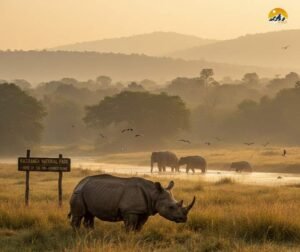
This park is home to the highest number of Great Indian One-Horned Rhinoceros in the world – more than 70% of the global population lives here! According to the latest reports, Assam now has over 4000 rhinos in total, and Kaziranga alone has around 2600+ (based on recent updates from Assam government and sources like IUCN and official counts). It’s also a Tiger Reserve since 2006, with the highest density of Royal Bengal Tigers anywhere in the world.
Here the Big Five are recognized – One-Horned Rhino, Bengal Tiger, Asian Elephant, Wild Water Buffalo, and Eastern Swamp Deer. Yaar, this place isn’t just about rhinos; it’s a living example of an entire ecosystem. If you search “Kaziranga National Park wildlife”, all this will pop up at the top.
History – How This Place Came to Be
Friends, when we talk about Kaziranga, the history is the most fascinating part. Yaar, this isn’t just a park; it’s India’s biggest and most inspiring wildlife conservation success story. Where rhinos were almost wiped out in the beginning, today it has the largest population of one-horned rhinos in the world. Let me tell you step by step in detail – like opening an old book and reading it out loud. Everything is based on facts.
Beginning: Late 19th Century and Early 20th Century – The Rhino Crisis
In the late 19th century, one-horned rhinos were quite common in Assam’s forests, but during British rule, hunting, poaching, and habitat loss reduced their numbers drastically. Around 1900, the total rhinos in India and Nepal were only 100–200. In Assam too, the situation was bad – local hunters, British sport hunting, and land-use changes pushed rhinos to the brink of extinction.
At that time, British Viceroy Lord Curzon (Lord Curzon of Kedleston) was in India. His wife Mary Curzon (Mary Curzon, Baroness Curzon of Kedleston), who was American by origin, visited Assam in 1904. She went to the Kaziranga area wanting to see rhinos. But even after a lot of effort by trackers, not a single rhino was spotted – only footprints. Mary was very upset and spoke to local guide Balaram Hazarika, who told her that poaching and hunting had reduced the rhinos drastically.
Mary immediately wrote to her husband Lord Curzon demanding a reserve for rhino protection. Lord Curzon proposed it on 4 November 1904, and that’s how Kaziranga’s conservation journey began. This was the moment when one woman’s concern paved the way to save an entire species.
1905: Establishment of Proposed Reserve Forest – The First Big Step
On 1 June 1905, under Notification 2442R, Kaziranga Proposed Reserve Forest was declared – initial area only 232 sq km (90 sq mi). This was the first major step in British India to save rhinos.
Then in 1908 it got full Reserved Forest status, and the area was expanded to 384 sq km (152 sq km extension to the east). But local communities and tea planters opposed it because their fishing, timber, and grazing rights were affected.
1916 to 1950: From Game Sanctuary to Wildlife Sanctuary
- 1916: Name changed to Kaziranga Game Sanctuary – hunting banned, but visitors allowed (initially for sport).
- 1938: Park opened to the public.
- 1950: After independence, “Game” was removed and it became Kaziranga Wildlife Sanctuary (suggested by P. D. Stracey). Now focus shifted fully to conservation.
During this time rhino numbers slowly started increasing, but poaching was still an issue. In 1954, the Assam government passed the Assam Rhinoceros Preservation Act – strict punishment for killing rhinos, and every death had to be investigated.
1960s-1970s: Becoming a National Park and Expansion
1968: Assam National Park Act passed – legal path to create national parks.
11 February 1974: Finally declared Kaziranga National Park – core area 430 sq km. This was when full protection came.
In this period poaching rose again – hundreds of rhinos killed in the 80s-90s. But the government and forest department increased armed guards, anti-poaching units, and intelligence.
1985: UNESCO World Heritage Site – Global Recognition
In 1985 UNESCO declared it a World Heritage Site under criteria (ix) and (x). Reason: ecological processes and biodiversity, especially the rhino recovery. UNESCO called it “the most spectacular achievement in saving the Indian one-horned rhinoceros from extinction.”
2006-2007: Tiger Reserve and Further Development
- 2006-2007: Declared Tiger Reserve – Laokhowa and Burachapori sanctuaries included. Tiger density now among the highest in the world.
- 2005: Park celebrated its centenary – 100 years from 1905.
- 2010s-2020s: Poaching dropped dramatically. Many years of zero poaching in the 2020s. Helped by Indian Rhino Vision 2020 and National Rhino Conservation Strategy.
Rhino Population History – Numbers That Inspire
- Early 1900s: Worldwide 100-200 rhinos (only 12-15 in Kaziranga).
- 1960s: Assam ~600.
- 2006: Kaziranga 1,855.
- 2009: 2,048.
- 2022: 2,613.
- 2025: Latest census shows 2,400+ in Kaziranga (Assam total 4,000+, India 3,300+, Nepal 700+).
This recovery is the world’s biggest conservation success – despite poaching, floods, habitat loss.
Challenges and Today’s Situation
History had floods (540 animals died in 2012), poaching peak in 90s, and local-wildlife conflict. But today armed rangers, drones, CCTV, community involvement, and eco-tourism keep everything under control. In 2025 poaching is near zero.
Friends, Kaziranga’s history shows that with willpower, nature can be saved. From Mary Curzon’s one worry to today, this park is an example for the whole world.
Geography and Climate – Nature’s Magic
Kaziranga is on the banks of the Brahmaputra River – north and east bordered by Brahmaputra, south by Mora Diphlu. The park has 5 main ranges – Western (Bagori), Central (Kohora/Mihimukh), Eastern (Agaratoli), Burapahar, and Northern.
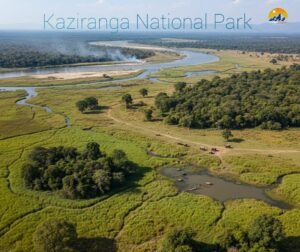
Friends, to understand Kaziranga, you have to understand its geography and climate separately, because these shape the entire ecosystem. Yaar, this park sits on the Brahmaputra floodplains – a place where floods come every year, new soil arrives, grass grows again, and animal life depends on it. Let me tell you in detail, like a local guide taking you around. Everything with latest info (up to 2025-2026 updates).
Location and Area – How Big Is This Park?
Kaziranga spreads across four districts of Assam: Golaghat, Nagaon, Sonitpur, and Biswanath. It’s on the south bank of Brahmaputra – north and east bordered by Brahmaputra itself, south by Mora Diphlu River, and inside Diphlu and Mora Dhansiri rivers flow.
Coordinates: Latitude 26°30′ N to 26°45′ N, Longitude 93°08′ E to 93°36′ E. Park is about 40 km east-west and 13 km north-south.
Area Details:
- Core area: about 430 sq km (165 sq mi) – main national park part.
- Total area (buffer, extension, additional zones): 1090+ sq km (some reports say up to 1307 sq km in 2025).
- In recent years Brahmaputra erosion took about 51 sq km, but government added extensions – extra habitat and safe corridor to Karbi Anglong hills.
This area is on the edge of the Eastern Himalaya Biodiversity Hotspot, so species diversity is super high. Check more on the official Assam Tourism page.
Topography – How the Land Looks
Kaziranga’s topography is mostly flat alluvial plain – Brahmaputra floodplain. Land slopes gently east-west and north-south. Average elevation 40 m to 80 m (131 ft to 262 ft). In the south are Karbi Anglong (Mikir) Hills up to 1220 m – natural refuge for animals during floods.
Main features:
- Vast grasslands (tall elephant grass) – 41% area.
- Marshlands and beels (lakes and wetlands) – 4-8% area, where water collects.
- Sandbars and riverine areas – along Brahmaputra.
- Chaporis (high grounds) – natural and artificial (made with army help) – animals shift here during floods.
- Open jungle, swamps, semi-evergreen forest.
All this creates a dynamic landscape – floods bring rich soil, grasslands renew.
Rivers and Water Bodies – Brahmaputra’s Magic
Four main rivers cross the park:
- Brahmaputra: north and east border – biggest and most important. Level rises 10-15 ft every monsoon.
- Mora Diphlu: south border.
- Diphlu and Mora Dhansiri: flow inside, create beels and ponds.
Hundreds of small and big beels (flood-fed lakes) – source of water and food for wildlife. Floods clean and enrich them.
Climate – Three-Season Subtropical Climate
Kaziranga has subtropical monsoon climate – heavy rainfall, high humidity, seasonal changes. Annual rainfall 2200-3000 mm (some reports 1500-2500 mm), mostly June to September.
Three main seasons:
- Monsoon/Rainy Season (June-September): Wettest period. Brahmaputra overflows, 70-80% park submerged for 5-10 days. Animals migrate to Karbi hills or chaporis. Floods recharge ecosystem – new soil, nutrients, grass growth. But sometimes losses too (several in recent years). Climate change making floods more intense.
- Summer/Pre-Monsoon (March-May): Hot and dry. Temperature up to 35-38°C. Animals stay near water (beels). Dry spells cause food shortage and forest fire risk.
- Winter (November-February): Mild and dry – best time to visit. Temperature min 5-10°C to max 25-30°C. Beels dry up, short grasses grow, animals easy to spot.
- Temperature range: Winter 5-10°C (sometimes 5°C), summer 35-38°C. Humidity high, especially in monsoon.
Role of Floods – Both Challenge and Necessity
Floods are natural process here – because of Brahmaputra. They maintain grasslands, clean invasive plants, bring nutrients. But intense floods (due to climate change) cause losses. Park has artificial high grounds and chaporis so animals stay safe.
Friends, this geography and climate make Kaziranga the most unique park in the world – where floods don’t bring death, but new life.
Flora of Kaziranga National Park – The Lush Jungle That’s the Foundation of the Ecosystem
Friends, the flora of Kaziranga National Park is so diverse and unique that it’s the real lifeblood of the park’s entire biodiversity. Here mainly four types of vegetation are found – alluvial grasslands (41% tall grass), open jungle, swamps, and evergreen forest.
The largest part (about 41%) is alluvial inundated grasslands, where tall elephant grass (Saccharum ravennae, Imperata cylindrica, Themeda arundinacea species) reaches 5-8 meters, serving as main food for rhinos, elephants, and other herbivores.
Besides that, open jungle and savanna woodland (about 29%) have semi-evergreen and moist deciduous trees like Aphanamixis polystachya, Dillenia indica, Garcinia tinctoria, Syzygium cumini, Albizia procera, Lagerstroemia speciosa, Mallotus philippensis, Bombax ceiba, and Tetrameles nudiflora, which provide shade and fruits.
Swamps and wetlands (4-8% area) are full of aquatic plants like water lily, lotus, hydrilla, water hyacinth (invasive but controlled by floods), and reeds, keeping beels alive. Annual floods recharge these grasslands – old grass washes away, new soil and nutrients come, and controlled burning promotes fresh growth.
Overall more than 1000 plant species are here, including rattan cane, orchids, climbing plants, and medicinal herbs. Yaar, this vegetation not only gives food and shelter to animals, but also balances the ecosystem amid floods, drought, and climate change – this green cover is what makes Kaziranga the world’s most unique grassland-dominated national park!
Fauna of Kaziranga National Park – Diversity and a Living Picture of Life
Friends, the real pride of Kaziranga National Park is its wildlife, where nature has created an amazing balance and one of the world’s greatest biodiversities can be seen here. The biggest attraction is the Great Indian One-Horned Rhinoceros – latest census shows about 2413 rhinos (around 2400+ as per recent estimates), which is more than 70% of the global population; seeing these giant animals grazing in grasslands or walking with their calves makes your heart happy.
Besides that, Royal Bengal Tiger density here is the highest in the world – 2024 tiger census recorded 148 tigers, over 100+, and sightings are now quite common. Asian Elephant numbers are 1900+, Wild Water Buffalo about 1666 (57% of world population), and Eastern Swamp Deer 468 – all part of the Big Five.
Smaller and larger mammals include Hog Deer, Sambar, Barking Deer, Wild Boar, Gaur, Sloth Bear, Leopard, Jungle Cat, Fishing Cat, Otters (Asian Small-clawed), and primates like Hoolock Gibbon (India’s only ape), Golden Langur, Capped Langur, Assamese Macaque – all in good numbers.
Talking about birds, more than 500 species – it’s an Important Bird Area, where in winter migratory and resident birds like Bar-headed Geese, Greater and Lesser Adjutant Storks, Eastern Imperial Eagle, Pallas’s Fish Eagle, Pelicans, Bengal Florican, Swamp Francolin, Hornbills, and Black-breasted Parrotbill can be seen.
Reptiles include Reticulated Python, Indian Rock Python, King Cobra, Indian Cobra, Russell’s Viper, Bengal Monitor, Water Monitor, and 15 types of turtles (like Assam Roofed Turtle), while 42+ fish species swim in beels and rivers.
Yaar, all this together creates a perfect food chain and ecosystem – where predators and prey stay in balance, and annual floods give new shape to their lives. Visiting Kaziranga feels like the whole jungle has come alive – you can feel the heartbeat of life in every corner!
Conservation Efforts at Kaziranga National Park
Friends, the conservation efforts at Kaziranga National Park are one of the strongest and most successful examples of wildlife conservation in India. Where rhino numbers were reduced to just 12-15 in the beginning, today more than 2400 one-horned rhinos are safe here – all thanks to strict anti-poaching measures, armed forest guards, drones, CCTV, intelligence networks, and high-tech smart patrolling.
In the 80s-90s poaching was at its peak, but now for many years zero or minimal poaching cases are reported, especially after 2020 thanks to Assam government’s ‘Rhino Vision 2020’ and ‘National Rhino Conservation Strategy’ plans. To tackle natural challenges like floods, artificial high grounds, chaporis, and emergency rescue teams are kept ready, while grassland management, controlled burning, and invasive species control keep the habitat healthy. By involving local communities through eco-tourism, homestays, and jobs, their interest has shifted from poaching to conservation.
Together with UNESCO, WWF, Assam Forest Department, and NGOs, these efforts not only protect rhinos but also strengthen tigers, elephants, and the entire biodiversity – it shows that if government, local people, and science come together, saving nature is possible. Yaar, this journey of Kaziranga teaches us that conservation is not a one-time job, but daily hard work and commitment!
Tourism at Kaziranga National Park – How to Go, When to Go, What to Do
Friends, tourism at Kaziranga National Park has become so popular that lakhs of people visit every year, especially wildlife and nature lovers. The best time is November to April, when the weather is pleasant, water is low, and animals are easily visible – best months December to March, because grass is short and sighting rate is very high.
The park remains open from 1 November to 30 April, and closed May to October due to floods. Easiest way to reach is Guwahati Airport (about 220 km) or Jorhat Airport (95 km), from where you can take taxi or bus to Kohora (Central Range); train to Furkating or Jakhalabandha stations are also good options.
Here three main safari options – Elephant Safari (early morning, most popular in Central and Western ranges, but seats very limited and advance booking must), Jeep Safari (available in all ranges – Central shows most animals, Western has more rhinos, Eastern good for birds and tiger sightings), and Boat Safari (on Brahmaputra near Bhomoraguri or Kaziranga, where you can see Ganges dolphins and birds).
Safari booking has to be done online on the official government website kazirangasafari.in – this is the only authentic site for bookings, so avoid fake ones! Book in advance because peak season fills up fast. For stay, government lodges like Bonani, Bonoshree, Aranya Niwas or private resorts, eco-camps, and homestays are plenty – from budget to luxury everything available. More details on Assam Tourism official page.
Doing safari with local guide is best, because they know animal locations and behavior very well. Tips: camera, binoculars, insect repellent, light clothes, and stay silent – don’t disturb animals. Yaar, the fun of safari in Kaziranga is something else – rhino grazing in morning mist, elephant herds, glimpse of tiger, and hundreds of birds chirping – all this together gives an experience you remember for life.
If you’re planning a trip to Assam, keep Kaziranga at the top – it’s not just sightseeing, it’s directly connecting with nature! If you want to see the beauty of Bharat, visit khubsuratbharat.com – you’ll get full Bharat darshan there.
Kaziranga National Park – A Living Heritage and Example of Conservation
Friends, Kaziranga National Park is not just a national park of Assam, but a living example of nature’s balance, human efforts, and ecosystem resilience. This jungle nestled in the lap of Brahmaputra has, over the last century, brought the one-horned rhino from near extinction to the world’s largest population (more than 2400+), while also providing safe shelter to tigers, elephants, wild buffalo, and countless birds and animals.
The annual floods here, which once seemed a challenge, today bring new life and nutrients to the ecosystem, while the human-nature struggle against poaching, climate change, and habitat loss is being won through amazing conservation efforts. As a UNESCO World Heritage Site and Tiger Reserve, Kaziranga is not only India’s conservation success story but a message to the whole world – that with willpower, community participation, and strict policies, nature can be saved and this magical jungle will remain green and lush for coming generations.
If you ever go to Assam, definitely visit Kaziranga – because here you don’t just see animals, you see the complete cycle of life in living form.
Friends, Kaziranga is not just a place to visit; it’s an experience. Connecting with nature, understanding conservation. If you’ve been or are planning to go, tell in the comments!
If you need more details – like “Kaziranga National Park safari price” or “Kaziranga tiger sighting tips” – check on junglejhadi.com or ask.
Answers to some important questions about Kaziranga.
1. Where is Kaziranga National Park located?
Friends, Kaziranga National Park is located in Assam, India. It spreads across Golaghat, Nagaon, Sonitpur, and Biswanath districts and lies on the floodplains of the mighty Brahmaputra River. This unique location is what makes its ecosystem so rich and alive.
2. Why is Kaziranga National Park so famous?
Kaziranga is world-famous because it is home to the largest population of the Great Indian One-Horned Rhinoceros. More than 70% of the world’s rhino population lives here. It is also a UNESCO World Heritage Site and a Tiger Reserve with the highest tiger density in the world.
3. What animals can be seen in Kaziranga National Park?
Yaar, Kaziranga is a complete wildlife package. You can see:
- One-Horned Rhinoceros
- Royal Bengal Tiger
- Asian Elephant
- Wild Water Buffalo
- Eastern Swamp Deer
- Leopard, Sloth Bear, Gaur
- Over 500 species of birds
That’s why it is called one of the richest wildlife parks in Asia.
4. What is the best time to visit Kaziranga National Park?
The best time to visit is from November to April.
The most ideal months are December, January, and February because:
- Weather is cool and pleasant
- Grass is shorter
- Wildlife sightings are much better
The park remains closed from May to October due to monsoon floods.
5. How can I book a safari in Kaziranga National Park?
Safari booking can be done only through the official government website: https://kazirangasafari.in
Here you can book:
- Jeep Safari
- Elephant Safari
Advance booking is highly recommended, especially during peak season.
6. What types of safari are available in Kaziranga?
There are mainly three types of safari:
- Elephant Safari – Early morning, best for close rhino sightings
- Jeep Safari – Most popular, covers all major ranges
- Boat Safari – On the Brahmaputra River, great for birds and dolphins
7. What is the safari price in Kaziranga National Park?
Safari prices depend on the season and type:
- Jeep Safari: Approx ₹2500–₹3500 per jeep
- Elephant Safari: Approx ₹1000–₹1500 per person
Prices may change, so always check the official booking website before planning.
8. How many one-horned rhinos are there in Kaziranga?
According to the latest census:
- Kaziranga has around 2400+ one-horned rhinos
- Assam has 4000+ rhinos in total
This makes Kaziranga the biggest success story of rhino conservation in the world.
9. Are tigers seen in Kaziranga National Park?
Yes, absolutely. Kaziranga has the highest tiger density in the world. While tiger sightings depend on luck, early morning jeep safaris especially in the Eastern Range offer good chances.
10. How many safari ranges are there in Kaziranga?
Kaziranga is divided into five main ranges:
- Central Range (Kohora)
- Western Range (Bagori)
- Eastern Range (Agaratoli)
- Burapahar Range
- Northern Range
Each range offers a different wildlife experience.
11. How can I reach Kaziranga National Park?
Reaching Kaziranga is quite easy:
- Nearest Airports: Jorhat (95 km), Guwahati (220 km)
- Nearest Railway Stations: Furkating, Jakhalabandha
- Road: Well connected via NH-37
12. Where can I stay near Kaziranga National Park?
You’ll find plenty of options:
- Government lodges like Bonani and Bonoshree
- Eco-resorts and jungle camps
- Budget hotels and homestays
Staying near the Central Range (Kohora) is the most convenient.
13. Is Kaziranga National Park safe for families and children?
Yes, it is very safe. Safaris are well regulated by the Forest Department, and trained guides accompany visitors. Just follow park rules and respect wildlife.
14. Why is Kaziranga a UNESCO World Heritage Site?
UNESCO declared Kaziranga a World Heritage Site in 1985 because:
- It represents the most successful conservation of the one-horned rhino
- It has a unique floodplain ecosystem
- It supports exceptional biodiversity
15. What should I carry while visiting Kaziranga?
A simple checklist:
- Camera and binoculars
- Light warm clothes (for winter mornings)
- Cap, sunscreen, insect repellent
- Patience and silence – jungle works on its own rules
16. Is one day enough to explore Kaziranga?
One day is possible, but 2 to 3 days are ideal:
- You can do multiple safaris
- Explore different ranges
- Enjoy birdwatching and river safari
17. Why is Kaziranga National Park a must-visit destination?
Because friends, Kaziranga is not just a national park. It is a living heritage, a conservation miracle, and a place where you truly feel the heartbeat of nature.
Now go, make a plan and visit Kaziranga!