Jim Corbett National Park: India’s Oldest National Park and the World’s Largest Home of Tigers!
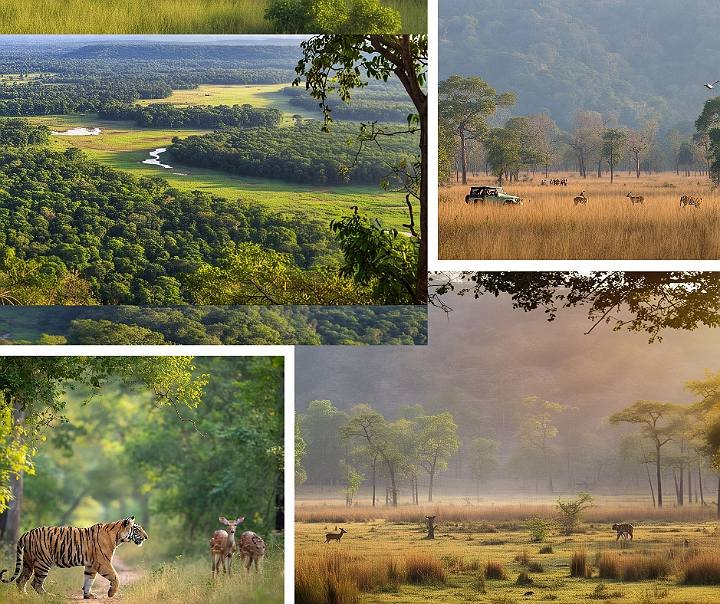
Brother, if we talk about Jim Corbett National Park, it’s not just a park; it’s a living example of India’s wildlife conservation. It is spread across the Nainital, Pauri Garhwal, and Almora districts of Uttarakhand, and it is Asia’s first National Park, established in 1936. Today, it is the core part of the Corbett Tiger Reserve, which has the highest density of tigers in the world.
The biodiversity here is so amazing that it is a living treasure of nature. Today, I will tell you even more details about this park – from history, geography, flora, and fauna to conservation efforts and safari zones. This post is for junglejhadi.com, where we share true and deep information about the forest. Come, let’s look at it in detail!
Jim Corbett National Park Infobox
Category | Information |
|---|---|
Location | Nainital and Pauri Garhwal districts, Uttarakhand, India |
Established | 1936 (Originally as Hailey National Park; India’s oldest national park) |
Area | Approximately 520 sq. km (200 sq. miles) (Core Area) |
Ecosystem Type | Sub-Himalayan belt; riverine belts, marshy depressions, and grasslands. |
Key Fauna (Major Animals) | Bengal Tiger, Indian Elephant, Chital, Sambar Deer, and King Cobra. |
Major River | Ramganga River (The lifeline of the park) |
Famous For | Being the first park to come under the Project Tiger initiative in 1973. |
Named After | Jim Corbett, a famous British-Indian hunter-turned-conservationist. |
Major Tourism Zones | Dhikala, Bijrani, Jhirna, Dhela, and Durga Devi. |
Best Time to Visit | November to June (Dhikala zone opens specifically from Nov 15th). |
Conservation Status | Protected Area (Tiger Reserve) |
The History of Jim Corbett National Park: A Journey from the Beginning to Now
Brother, the story of Jim Corbett National Park is very old, inspiring, and a bit dramatic. This isn’t just the history of a park, but the entire story of the beginning of wildlife conservation in India. Let’s look at everything in detail, like a friend sitting down and telling old stories.
Ancient and Pre-British Raj Background
This area is very old. Earlier, it was under the King of Tehri Garhwal. In the 19th century, forests were cleared to protect against Rohilla invaders. After the fight with the Gurkhas in 1815-1820, the King gave some land to the East India Company. After the British Raj arrived, Major Ramsay made the first plan to protect this forest in 1858 because the area was very fertile (temperatures range from 8°C to 32°C in winter). In 1861-62, farming and cattle grazing were banned, cattle sheds were demolished, and a cadre of workers was created to fight forest fires. In 1868, the British Forest Department took control, and in 1879, it was declared a Reserved Forest – where timber cutting was allowed only for domestic use.
The Idea of a Game Reserve in the 1900s and Jim Corbett’s Role
In the early 1900s, British officers like E.R. Stevans and E.A. Smythies suggested making a National Park here. In 1907, the plan for a Game Reserve came up, but the actual work started in the 1930s. This is where the name of Jim Corbett (Edward James Corbett, 1875-1955) comes in. He was a Colonel in the British-Indian Army, but the world knew him as “Carpet Sahib.” Jim Corbett killed the man-eater tigers and leopards of Kumaon and Garhwal (like the Champawat Tiger – responsible for 436 deaths, killed in 1907; the Panar Leopard – 400+ deaths; and many more). He wrote books like “Man-Eaters of Kumaon” (1944), which became a bestseller.
But later, Jim Corbett left hunting and became a conservationist. He worked with Frederick Walter Champion (the first wildlife photographer) for wildlife preservation. In 1934, he spoke to Governor Sir Malcolm Hailey and helped create India’s first National Park. He started the All India Conference for the Preservation of Wild Life and helped form the Association for the Preservation of Game in the United Provinces.
1936: Asia’s First National Park – Hailey National Park
On April 1, 1936 (August 8 in some sources), Hailey National Park was created in the name of Sir Malcolm Hailey – covering an area of 323.75 sq km. This was the first National Park in India and Asia. Hunting was banned here, and timber cutting was only allowed for domestic use. Soon, strict rules were made against killing or capturing mammals, reptiles, and birds. It was doing well in the 1930s, but during the Second World War, more poaching and timber cutting occurred.
Name Changes and Development After Independence
After independence, in 1954-55, the name was changed to Ramganga National Park (after the Ramganga River). Then in 1955-56 (1957 in some sources), it was renamed Corbett National Park in honor of Jim Corbett. Jim Corbett had played a major role in conservation before his death in 1955.
1973: The Birth of Project Tiger – Corbett as the First Reserve
In 1973, the Government of India launched Project Tiger – during PM Indira Gandhi’s time. This was the world’s largest tiger conservation program. Corbett became its first location. At that time, there were only 268 tigers in the country, but today there are 3,682+. This project was a super success in Corbett.
1991 Expansion and Corbett Tiger Reserve
In 1991, the park was expanded – Sonanadi Wildlife Sanctuary (301.18 sq km) was included to create the Corbett Tiger Reserve. The total area is now 1,288.31 sq km (Core 821.99 sq km + Buffer 466.32 sq km). This is part of the WWF’s Terai Arc Landscape Program, where 13 protected areas of India and Nepal are being connected by corridors so that tigers, elephants, and rhinos can migrate.
Current Status (2025-2026 Updates)
Today, Corbett has the highest tiger density in the world – 260+ tigers (2022 census, numbers may increase with 2025 updates). Under the NTCA, there is strong monitoring, camera traps (550+), drones, and an anti-poaching force. Visitors in 2023-24 were 365,000+. This park is an example of India’s wildlife protection – where the dream of Jim Corbett, who turned from a hunter to a conservationist, is a reality today.
- Read more – Tiger Reserves in India with their Locations, Conservation and facts
- Tiger : birth, habitat, diet, subspecies, conservation and much more
Brother, this history shows how a small reserve forest became the world’s largest tiger home today. If you read Jim Corbett’s books, it feels as if he is telling the story himself.
Geography and Area: Park Size, Topography, and Geographical Features – In Detail
Brother, looking at the geography of Jim Corbett National Park, it feels as if nature has put everything together here – mountains, valleys, rivers, grasslands, and that too in such a varied way that every corner offers a new view. This park is spread across Uttarakhand’s Nainital, Pauri Garhwal, and Almora districts, and is nestled in the sub-Himalayan belt.
To the north are the hills of the Lesser Himalaya, to the south are the Siwalik Hills (also called Shivalik), and in between is a structure like the Doon Valley. This entire area is part of the Terai-Bhabar region, where the ground is porous – filled with boulders, gravel, and sand brought by erosion from the Himalayas and Siwalik. This porosity absorbs water well, keeping the forest dense and full of water.
Now let me tell you the exact area details (updated from official and reliable sources like NTCA and Corbett Tiger Reserve). The entire Corbett Tiger Reserve (which includes both the National Park + Buffer Zone) is 1,288.31 square kilometers. Out of this, the core area (which is actually called Jim Corbett National Park, including the Sonanadi Wildlife Sanctuary) is 821.99 square kilometers.
In old records, the core appeared as 520.8 sq km, but in 1991, when Sonanadi Wildlife Sanctuary (301.18 sq km) was included and the Kalagarh Forest Division was added, the core became larger. The buffer zone is 466.32 square kilometers. These numbers are confirmed by official NTCA data – overall, it is one of the most important and largest tiger reserves in India.
Speaking of topography, it is the most amazing thing about the park. The ground here is never flat – it is undulating, meaning there is a lot of variation in height and depth. The elevation (height) starts from 360 meters (about 1,180 feet) and goes up to 1,220 meters (4,000 feet). In some places, the maximum is stated as 1,040 meters, but it reaches up to 1,210-1,220 meters at places like Kanda Ridge. The lower areas (Bhabar and lower Siwalik) remain hot and humid, while the upper ridges are cold and dry. This variation creates different microhabitats – both Himalayan and plains-type animals and plants are found here.
The main topographic features of the park are:
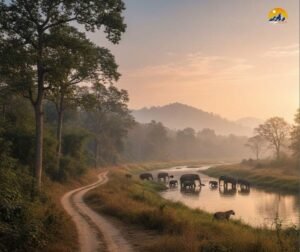
- Patli Dun Valley: This is the largest and most beautiful part of the park. It is a long, narrow valley created by the Ramganga River. Doons or Duns are formed by tectonic activity (not by erosion), and they have a floor filled with boulders, gravel, and sand. Patli Dun is in the northern part of the park – if you look from the Dhikala zone, you get an amazing view: large chaurs (grasslands) in front and the Kanda Ridge as a backdrop. Dhikala Chaur is in this valley, offering a panoramic view. This valley gives the park a different level of beauty, and the Ramganga can be seen flowing from here.
- Rivers and Riverine Belts: The Ramganga River is the main lifeline – originating from the Lesser Himalaya, it passes through the park for about 40 km and leaves near the Kalagarh Dam. Apart from this, there are smaller rivers and streams like Khoh, Kosi, Mandal, Sonanadi, and Palain. These rivers create riverine habitats – sandy banks, gravel beds, boulders, and marshy areas where gharials, muggers, otters, and fish are abundant. The rivers cut through the valley and provide a year-round source of water, keeping animals active even in the dry season. There is a large water body near Kalagarh Dam, which attracts many migratory birds in winter.
- Hills, Ridges and Ravines: Due to the Siwalik Hills, there are many broad ridges, such as Kanda Ridge behind Dhikala. These ridges are made of hard sandstone and covered with Sal forests. Ravines (deep gullies), minor streams, and small plateaus are spread everywhere. All these support different vegetation due to different slopes and aspects (north-south facing). Chir Pine (the only conifer of pine) is found on the upper ridges, giving it a Himalayan feel.
- Grasslands (Chaurs): 10% of the park’s area (up to 20% in the old core according to some sources) is covered with open grasslands, locally called chaurs. These are large grasslands – such as Dhikala Chaur, Bijrani Chaur, Phulai Chaur, Khinanuli Chaur, Paterpani, Mohanpani, Bhadhai, etc. These chaurs are perfect feeding grounds for herbivores (Chital, Sambar, Elephants, Wild Boar), and tigers can hunt easily here. In summer, they turn golden, and the view is very beautiful.
- Marshy Depressions and Other Features: In the lower areas, there are marshy depressions where water accumulates, and small lakes as well. All these together make the park like a mosaic – dense forest (73%), open grasslands (10%), river belts, hills, valleys, and marshes.
Brother, if you look at the map, you will understand – looking from above, you see Siwalik ridges on one side, Patli Dun valley in the middle, Ramganga cutting through, and chaurs and streams everywhere. This is the reason why the tiger density here is the highest in the world – every animal gets its favorite habitat. This varied geography makes the park so unique and rich in biodiversity.
Flora: Complete Detailed List of Trees, Plants, and Vegetation
Friend, looking at the flora of Jim Corbett National Park, it feels as if nature has opened its entire treasure chest here. According to the Botanical Survey of India and the Wildlife Institute of India, 617 plant species have been recorded here (it was 488 in the 1970s, but increased to 617 by 2023). These include 110 tree species, 51 shrubs, 27 climbers, 33 bamboos, and grasses. 73% of the park’s area is covered with dense moist deciduous forest, where Sal (Shorea robusta) is the most dominant – it alone makes up 40-75% of the forest cover (various sources say 40% to 75%, but the latest is part of the 73% moist deciduous forest) and is the main basis of the park’s greenery. These Sal forests are so dense that sunlight barely reaches the ground, and they provide shade, food, and cover to animals.
The vegetation types of the park are very varied: Sal forest (dominant), Khair-Sissoo forest (in riverine areas where Khair and Sissoo come first and make the soil fertile), Chir Pine (on ridges), Bamboo forest (in some parts), and open grasslands (chaurs) where grasses are dominant. Different types of plants are found in river belts, and herbs and ferns in marshy areas. All these together create different habitats, which keep the biodiversity so rich.
Detailed list of main trees here:
- Sal (Shorea robusta) – Most prominent, forms a dense canopy, 20-25 meters high, large leathery leaves.
- Sissoo (Dalbergia sissoo) or Sheesham – Fast-growing, durable wood, curved trunk, 10-15 meters high.
- Khair (Acacia catechu) – Common in riverine areas.
- Peepal (Ficus religiosa) – Sacred, large leaves.
- Rohini – Common.
- Mango (Mangifera indica) – Fruit tree.
- Haldu (Adina cordifolia) – Medium size, smooth gray bark, fragrant flowers.
- Anogeissus latifolia – Important.
- Chir Pine (Pinus roxburghii) – Only conifer, on ridges, Himalayan species.
- Banj Oak (Quercus leucotrichophora) – In upper areas, Himalayan.
- Bombax ceiba (Semal) – Large red blooms, 20 meters high, cotton-like fibers from fruit.
- Butea monosperma (Dhak/Flame-of-the-forest) – Bright orange flowers.
- Bauhinia variegata (Kachnar) – Pink-white flowers.
- Cassia fistula (Amaltas) – Yellow chandelier-like flowers.
- Erythrina indica (Madaar/Indian Coral) – Scarlet red flowers.
- Aegle marmelos (Bael), Zizyphus mauritiana (Ber), Lannea coromandelica (Jhingan), Holoptelea integrifolia (Kanju) etc.
Flowering trees make the park colorful – Red blooms of Semal, Orange of Dhak, and Yellow of Amaltas in March-April.
- Shrubs: Ber (Zizyphus), Maror Phali (twisted pods), Karaunda (pinkish-white flowers, sour fruit), Lantana (invasive).
- Grasses: Largest group, 70+ species – Kansi (Saccharum sp.), Themeda arundinacea, Baib/Bhabar (Eulaliopsis binata), Narkul (Arundo donax), Tiger Grass (Thysanolaena maxima), Khus Khus (Vetiveria zizanioides), Spear Grass (Heteropogon contortus – sharp blades), Cymbopogon flexuosus (aromatic). These are dominant in chaurs.
- Bamboo: Male Bamboo (Dendrocalamus strictus) – Clustered stems, papery sheaths. In the bamboo flowering cycle, all flower and die together.
- Others: Climbers, ferns, herbs, medicinal plants. Some artificially planted like Teak, Eucalyptus, Jacaranda, Silver Oak, Bottlebrush.
This varied flora supports different habitats (Sal forest, chaurs, river belts) and provides food and shelter to animals.
Fauna: Mammals, Birds, Reptiles – Full Detailed List
Brother, looking at the fauna of Jim Corbett National Park, it feels as if every kind of animal has made its home here. This park is a huge treasure of biodiversity, where 50+ mammal species, 580-669 bird species (both resident and migratory), 25-33 reptile species, 7 amphibians, 7 fish species, and up to 36 dragonflies are recorded. These numbers are taken from official sites, Wikipedia, NTCA, and bird checklists (up to 669 on Avibase) and are updated to 2025-2026. The varied geography of the park (Sal forest, chaurs, rivers, hills) supports all of them.
First, let’s talk about mammals (50+ species). The Royal Bengal Tiger is the biggest attraction here – in the 2022 census, there were 260+ tigers in Corbett Tiger Reserve (the highest density in the world, 14-20 per 100 sq km). These tigers hunt large prey like elephant calves, sambar, and chital.
Mammals (50+ species):
- Royal Bengal Tiger – 260 (2022 census, highest density in any single reserve, 14-20 per 100 sq km) – Star attraction.
- Asiatic Elephant – 1,100+ (in herds, 1,100+ in 2019, increasing).
- Indian Leopard – Both in hilly and lowland.
- Sloth Bear – Common.
- Himalayan Black Bear (Asiatic Black Bear).
- Spotted Deer (Chital) – Most common herbivore.
- Sambar Deer – Large, tiger’s favorite prey.
- Hog Deer (rare).
- Barking Deer (Kakar).
- Wild Boar.
- Jungle Cat, Fishing Cat, Leopard Cat – Small felines.
- Yellow-throated Marten.
- Indian Gray Mongoose.
- Smooth-coated Otters – In the river.
- Himalayan Goral.
- Indian Pangolin.
- Langur and Rhesus Macaque – monkeys.
- Others: Dhole (Wild Dog), Jackal, etc.
Birds (580-600+ species, up to 669 in some checklists):
- Crested Serpent Eagle – Common raptor.
- Indian Paradise Flycatcher – Beautiful.
- Greater Coucal.
- Blossom-headed Parakeet.
- Red Junglefowl – The rooster of the forest.
- Great Pied Hornbill.
- White-backed Vulture.
- Hodgson’s Bushchat.
- Orange-breasted Green Pigeon.
- Pallas Fish Eagle – Rare.
- Golden Oriole.
- Tawny Fish Owl.
- Indian Pitta – Bright colors.
- Scarlet Minivet.
- Indian Peafowl (Peacock), Kingfishers, Woodpeckers, Owls, Nightjars.
- Water Birds: Cormorants, Darter, Grey Heron, Egrets, Spotbill, etc.
- Migratory: Ducks, Geese, Wagtails, etc. (in winter).
- Other Common: Red-wattled Lapwing, Pied Kingfisher, Eurasian Collared Dove, etc.
Reptiles (25-33 species):
- Gharial (critically endangered) – In the Ramganga.
- Mugger Crocodile (Marsh Crocodile).
- King Cobra.
- Common Krait.
- Indian Cobra.
- Russell’s Viper.
- Indian Python (Rock Python).
- Monitor Lizard (Bengal Monitor) – Largest.
- Others: Snakes, Lizards, etc.
Others: 7 amphibians (frogs, toads), 7 fish (Mahseer, Goonch, Rohu, etc.), dragonflies.
All these are found around the Ramganga and waterholes. Gharials and muggers have been released through conservation efforts.
Conservation Efforts: How is this Park Being Saved?
Brother, the conservation story of Jim Corbett National Park (or Corbett Tiger Reserve) is the biggest success story of India’s wildlife protection. This park was the first reserve of Project Tiger, which started on April 1, 1973, and today it is the tiger reserve with the highest density in the world.
According to the latest information (from 2022-2023 census and 2025 updates), there are 260+ tigers here (up to 260-266 in some reports), which is the highest in any single reserve. There are a total of 560 tigers in Uttarakhand, and Corbett takes the largest share. This number has increased from only 268 tigers (in the whole country) in 1973 to 3,682+ (in the country) today, in which Corbett has a big role.
How is all this happening? Let’s see step by step:
- Role of Project Tiger and NTCA – Basic Framework: Project Tiger is the largest wildlife program of the Government of India, running under the Ministry of Environment, Forest and Climate Change. The National Tiger Conservation Authority (NTCA) was formed in 2005, which manages Tiger Reserves. NTCA guidelines are followed in Corbett – strict protection in the core area (821.99 sq km) and community involvement in the buffer zone (466.32 sq km). A National Tiger Census is held every 4 years (currently ongoing in 2025, with 550+ camera traps installed in Corbett). This census checks the count, movement, and health of tigers through camera traps, pugmarks, and DNA analysis.
- Anti-Poaching and Protection Measures – The Strongest Part: Poaching was the biggest threat, but now it has reduced significantly.
- Special Tiger Protection Force (STPF) – Trained force, regular patrolling.
- E-eye Project – Electronic eye, remote area monitoring through camera traps, drones, and satellite surveillance.
- Wireless communication and GIS mapping for real-time tracking.
- Forest fire control, invasive species (like Lantana) removal, and habitat restoration.
- Translocation: Healthy tigers are shifted to other reserves (like Rajaji) to increase genetic diversity.
- Veterinary Unit and Quick Response Team – Animal Health and Rescue: Corbett has a state-of-the-art veterinary unit. Trained professionals handle wildlife and captive animals’ healthcare, rescue operations, and emergencies. If a tiger or elephant is injured or caught in human-animal conflict, the Quick Response Team arrives. The toll-free number for conflict reporting is 1800 890 1975.
- Human-Wildlife Conflict Management – The Biggest Challenge: Sometimes conflict occurs with local villagers due to the increasing number of tigers (there are 2,939 people around 46 villages).
- “Living with Tigers” Initiative – Awareness, training, and alternative livelihoods (like eco-tourism) for the community.
- Beehive Fencing Project “Corbee Honey” – Keeping elephants and tigers away using bee fencing, and income for locals from honey.
- Eco-Development Committees – Involving villagers in conservation for alternative jobs and resource management.
- Voluntary Relocation – Shifting some villagers out of the core to increase habitat.
- WWF and Terai Arc Landscape Program – International and Trans-border Cooperation: Corbett is part of WWF’s Terai Arc Landscape (TAL) program, which connects 13 protected areas between India and Nepal through corridors. This ensures gene flow and migration for tigers, elephants, and rhinos. WWF-India, the Wildlife Institute of India (WII), and local communities work together to secure corridors, stop wildlife trade, and reduce HWC (Human-Wildlife Conflict).
- Other Initiatives and Challenges:
- Habitat Restoration – Restoring degraded forests and wetlands.
- Prey Base Management – Increasing the population of prey animals like Chital and Sambar.
- Eco-Tourism Regulation – Revenue from tourism is used in conservation, but with strict rules to reduce disturbance.
- Challenges: Invasive species, forest fires, encroachment, highway construction (which fragments habitat), and territorial fights (due to high density of tigers). But these are handled through strong monitoring.
Brother, this success of Corbett shows that when Government, NTCA, WWF, local communities, and science work together, even the impossible becomes possible. The number of tigers has increased, biodiversity is safe, and this park is an example for the world. You will continue to get more such deep information on junglejhadi.com.
Safari Zones: Division of the Park and Their Special Features
There are 7-8 zones for tourism in the park:
- Dhikala Zone – Largest, grasslands, river channels, best tiger sightings.
- Bijrani Zone – Open grasslands, mixed forests.
- Jhirna Zone – Open year-round, sloth bears, tigers.
- Dhela Zone – Big grasslands, wealthy flora-fauna, open year-round.
- Durgadevi Zone – Hilly, birdwatching, Ramganga-Mandal rivers.
- Sonanadi Zone – Dense forests, elephants.
- Garjiya Zone – River views.
- Sitabani Buffer Zone – Temples, birds (not core).
These zones offer entry through different gates.
Why is this Park so Special?
Brother, Jim Corbett National Park is an entire ecosystem – history, diverse flora-fauna, high tiger density, and successful conservation. It is an example of India’s wildlife protection. Keep visiting junglejhadi.com for more such deep information. If you need any other details, let me know!
Read more:
- Sanjay Gandhi National Park : Its Geography, Biodiversity, Wildlife
- Kanha National Park : explore its history, geography, flora, fauna
- Biosphere Reserves in India : Its list with interesting facts
Jim Corbett National Park – Frequently Asked Questions
Where is Jim Corbett National Park located?
Brother, Jim Corbett National Park is located in the Indian state of Uttarakhand. It spreads across the Nainital, Pauri Garhwal, and Almora districts and lies in the beautiful sub-Himalayan Terai region.
When was Jim Corbett National Park established?
Brother, the park was established on 1 April 1936, making it the oldest National Park in India and the first in Asia. Initially, it was named Hailey National Park.
Why is it called Jim Corbett National Park?
Brother, the park was renamed Jim Corbett National Park in 1955–56 to honor Edward James Corbett, a legendary hunter who later became a passionate wildlife conservationist and played a major role in protecting India’s forests and wildlife.
Is Jim Corbett National Park the first National Park in Asia?
Yes brother, absolutely. Jim Corbett National Park is proudly recognized as Asia’s first National Park.
What is the total area of Jim Corbett National Park?
Brother, the total area of the Corbett Tiger Reserve is 1,288.31 square kilometers, which includes:
- Core Area: 821.99 sq km
- Buffer Zone: 466.32 sq km
How many tigers are there in Jim Corbett National Park?
Brother, according to the 2022 Tiger Census, there are 260+ Royal Bengal Tigers in Corbett, giving it the highest tiger density in the world. The number may increase further with the 2025 census.
Why is Jim Corbett called the “World’s Largest Home of Tigers”?
Brother, Corbett earns this title because:
- It has the highest tiger density globally
- A strong prey base like Chital, Sambar, and Wild Boar
- Perfect habitat mix of forests, grasslands (chaurs), and rivers
How many safari zones are there in Jim Corbett National Park?
Brother, there are 8 major safari zones:
- Dhikala Zone
- Bijrani Zone
- Jhirna Zone
- Dhela Zone
- Durgadevi Zone
- Sonanadi Zone
- Garjiya Zone
- Sitabani Buffer Zone
What is the best time to visit Jim Corbett National Park?
Brother, the best time to visit is:
- November to June – Ideal for safaris
- March to May – Best chance for tiger sightings
Most zones remain closed during the monsoon season (July–October).
Is Jim Corbett National Park open throughout the year?
Brother, not all zones.
- Jhirna and Dhela Zones are open all year
- Dhikala, Bijrani, and Durgadevi Zones close during monsoon
What animals can be seen in Jim Corbett National Park?
Brother, the park is home to 50+ mammal species, including:
- Royal Bengal Tiger
- Asiatic Elephant
- Indian Leopard
- Sloth Bear
- Sambar and Chital
- Gharial and Mugger Crocodile
- 580–600+ bird species
Which forest type is most dominant in Jim Corbett National Park?
Brother, Sal Forest (Shorea robusta) dominates the park, covering nearly 40–75% of the total forest area.
When did Jim Corbett become part of Project Tiger?
Brother, in 1973, when India launched Project Tiger, Jim Corbett became India’s first Tiger Reserve.
Are elephants found in Jim Corbett National Park?
Yes brother, Corbett is home to 1,100+ Asiatic Elephants, making it one of the most important elephant habitats in northern India.
Is Jim Corbett National Park safe for visitors?
Brother, absolutely. The park is protected by:
- Special Tiger Protection Force (STPF)
- Camera traps and drones
- NTCA monitoring
- Quick Response and veterinary teams
Why is Jim Corbett National Park so special?
Brother, because it has:
- Asia’s first National Park status
- Highest tiger density in the world
- Rich biodiversity
- Successful conservation model
- Historic role in Project Tiger
Where can I find more authentic information about Jim Corbett National Park?
Brother, for deep, genuine, forest-based information, keep visiting:
https://junglejhadi.com